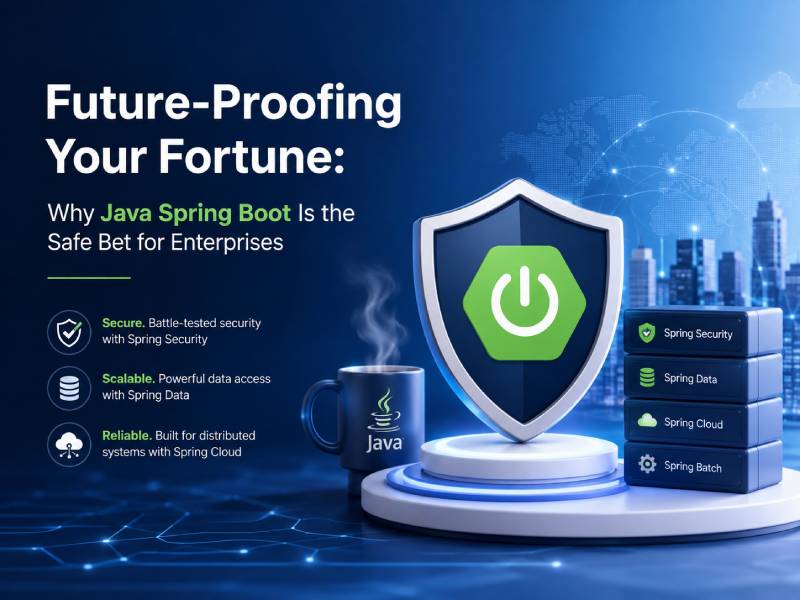
Introduction: The Cost of "Shiny Object" Syndrome
Every quarter, a new framework promises to change everything. AI-assisted development, Rust's memory safety guarantees, Go's concurrency model — the tech landscape moves fast, and it's easy for a CTO or VP of Engineering to feel the pull of the next big thing. Innovation is exciting. It's also expensive when it's wrong.
Here's the question that should dominate any serious technology stack decision for a 5-10 year digital transformation initiative:
In a world of rapid innovation, how do you choose a framework that won't be obsolete in three years?
This isn't a rhetorical question. It has real financial consequences — re-platforming costs, retraining costs, the opportunity cost of engineers learning a new ecosystem instead of shipping features. The answer, for most enterprises, isn't the fastest hare in the race. It's the tortoise.
Spring Boot has been the backbone of enterprise Java development for over a decade. It isn't flashy. It doesn't trend on Hacker News every week. What it does is compound reliability, year over year, on top of an ecosystem that has already solved the hard problems — security, transaction management, distributed systems, observability — that a newer framework's community is still debating. When the goal is a decade-long transformation, not a hackathon demo, stability isn't the boring choice. It's the strategic one.
This article makes the business and technical case for Spring Boot as the foundation of your next enterprise initiative, with concrete patterns for legacy modernization, high-volume transaction processing, and event-driven architecture.
Section 1: The Spring Boot Ecosystem — The "Fortress"
The single biggest risk in adopting any framework is not the framework itself — it's everything around it. Does it have a security model that's been battle-tested against real attack vectors? Does it have a data access layer that handles edge cases you haven't thought of yet? Does it have a migration path when your architecture inevitably changes?
Spring Boot's advantage isn't any one feature. It's the depth and maturity of the surrounding ecosystem:
- Spring Security — a security framework with over a decade of hardening against OAuth2, SAML, JWT, CSRF, and session-fixation attack patterns, actively maintained and audited by a large open-source community.
- Spring Data — a consistent abstraction layer across relational (JPA), NoSQL (MongoDB, Cassandra, Redis), and reactive data stores, so your team isn't relearning a new query paradigm every time the data layer changes.
- Spring Cloud — a suite of libraries purpose-built for distributed systems: service discovery, configuration management, circuit breakers, and API gateways.
- Spring Batch — a mature framework for high-volume, transactional batch processing (nightly reconciliation jobs, ETL pipelines, regulatory reporting) that most newer frameworks simply don't have an equivalent for.
If a module has a bug, there is a very high chance someone else has already hit it, filed the issue, and documented a workaround. That's the difference between a two-hour fix and a two-week outage during a board-level incident review.
Section 2: Practical Enterprise Use Cases — The "How"
Ecosystem maturity is only valuable if it translates into practical patterns your teams can execute. Here are three of the most common enterprise scenarios, with the concrete Spring Boot tooling that addresses them.
Use Case A: Legacy Modernization (The Strangler Pattern)
Most enterprises don't get to modernize on a blank slate. You have a J2EE monolith, a COBOL mainframe, or a legacy .NET Framework application that the business depends on today, while you build its replacement for tomorrow. A "Big Bang" cutover — shut down the old system, flip a switch, turn on the new one — is one of the highest-risk moves an engineering org can make, and it's the reason so many modernization projects end up in post-mortems.
The Strangler Fig Pattern is the alternative: incrementally build new functionality as independent services, and gradually reroute traffic away from the legacy system until it can be safely retired.
Practical implementation: Use Spring Cloud Gateway as the traffic router sitting in front of both the legacy system and the new microservices. Routes are moved one at a time, by business capability, not by a single cutover event.
Architecture Diagram: Strangler Pattern Migration
                      [Client Requests]
                            |
                            v
                    [Spring Cloud Gateway]
           (single entry point; routes configured externally)
                 |                              |
        (legacy) |                              | (migrated)
                 v                              v
     [Legacy J2EE/COBOL Monolith]           [New Spring Boot Microservices]
                 |                              |
                 |                              |
                 +-------> shared DB <----------+
                       (during transition)


Over time, routes shift from left to right until the legacy system handles zero traffic and can be decommissioned.
Code Snippet: Spring Cloud Gateway Route Configuration
# Example Spring Cloud Gateway route configuration
spring:
  cloud:
    gateway:
      routes:
        - id: legacy-order-service
          uri: http://legacy-monolith:8080
          predicates:
            - Path=/api/orders/**
        - id: new-inventory-service
          uri: lb://inventory-service   # already migrated, load-balanced
          predicates:
            - Path=/api/inventory/**
This gives stakeholders something crucial: a rollback path at every stage. If the new inventory service has a defect, you revert one route in the gateway config — not the entire migration.
Use Case B: High-Volume Transactional Systems
Banking, insurance, and financial-services workloads are unforgiving. Data integrity isn't a nice-to-have; it's a regulatory requirement. Spring Boot's transaction management, layered on Hibernate and Spring Data JPA, is one of the most proven combinations in the industry for exactly this kind of workload.
Practical implementation:
- Hibernate handles the object-relational mapping complexity — inheritance hierarchies, lazy loading, caching — without your team hand-writing SQL for every entity relationship.
- Spring Data JPA provides the repository pattern, cutting boilerplate CRUD code dramatically while still allowing custom queries where needed.
@Transactionalannotations give you declarative control over commit/rollback boundaries, isolation levels, and propagation behavior — critical when a single business operation (e.g., "transfer funds") touches multiple tables and must succeed or fail atomically.
Code Snippet: Transactional Funds Transfer Service
@Service
public class FundsTransferService {

    private final AccountRepository accountRepository;
    private final LedgerRepository ledgerRepository;

    public FundsTransferService(AccountRepository accountRepository,
                                 LedgerRepository ledgerRepository) {
        this.accountRepository = accountRepository;
        this.ledgerRepository = ledgerRepository;
    }

    @Transactional(isolation = Isolation.SERIALIZABLE, rollbackFor = InsufficientFundsException.class)
    public void transfer(Long fromAccountId, Long toAccountId, BigDecimal amount) {
        Account from = accountRepository.findByIdForUpdate(fromAccountId);
        Account to = accountRepository.findByIdForUpdate(toAccountId);

        if (from.getBalance().compareTo(amount) < 0) {
            throw new InsufficientFundsException(fromAccountId);
        }

        from.debit(amount);
        to.credit(amount);

        accountRepository.save(from);
        accountRepository.save(to);
        ledgerRepository.record(new LedgerEntry(fromAccountId, toAccountId, amount));

        // If any exception is thrown above this point,
        // Spring rolls back the entire transaction automatically.
    }
}
The value here isn't the syntax — it's that @Transactional removes an entire category of manual error-handling code your team would otherwise have to write, test, and maintain by hand. That's engineering time redirected toward business logic instead of transaction plumbing.
Use Case C: Event-Driven Microservices
Modern enterprise systems rarely operate in a single request/response model. Inventory updates, order-status changes, and fraud-detection signals all need to propagate across services asynchronously, without tightly coupling one service's uptime to another's.
Practical implementation: Spring Cloud Stream provides a unified programming model over messaging brokers like Kafka or RabbitMQ, so your business logic doesn't need to know or care which broker is underneath — a meaningful advantage if your infrastructure strategy changes down the line.
Architecture Diagram: Event-Driven Order Processing
[Order Service] --publishes--> [Kafka Topic: order-events]
                                        |
                    -----------------------------------------
                    |                    |                   |
                    v                    v                   v
        [Inventory Service]   [Notification Service]   [Analytics Service]
        (decrements stock)    (emails customer)         (updates dashboards)


Each consumer scales independently. If the Notification Service goes down, Inventory and Analytics are unaffected -- Kafka retains
the event until the consumer recovers.
Code Snippet: Spring Cloud Stream Consumer
@Bean
public Function<OrderEvent, InventoryUpdate> processOrder() {
    return orderEvent -> {
        // decouples inventory logic from the order service entirely
        return inventoryService.reserveStock(orderEvent.getSku(), orderEvent.getQuantity());
    };
}
This decoupling is what allows enterprise systems to scale teams, not just servers — different teams can own the Inventory, Notification, and Analytics services independently, deploy on their own schedules, and fail without cascading.
Section 3: Addressing the "Heavyweight" Myth
Java has a reputation problem that's roughly a decade out of date: slow startup times, high memory footprint, verbose configuration. It's worth addressing directly, because it's the most common objection raised in stack-selection meetings — and it no longer holds up.
- Spring Boot Actuator gives you production-grade observability out of the box — health checks, metrics, and thread-dump endpoints — without bolting on third-party monitoring agents.
- GraalVM Native Image support allows Spring Boot applications to compile ahead-of-time into native executables, cutting startup time from seconds to milliseconds and reducing memory footprint dramatically — directly answering the "Java is too heavy for containers/serverless" critique.
- Project Loom (Virtual Threads), now part of the standard JDK and fully supported in current Spring Boot releases, allows a single application to handle vastly more concurrent connections using a fraction of the OS threads previously required — meaning fewer servers to reach the same throughput.
"The heavyweight criticism describes Java as it existed in 2010 — not a GraalVM-compiled, virtual-thread-enabled Spring Boot service running today."
Enterprises that dismiss the platform on outdated assumptions are making a decision based on stale data — exactly the kind of risk this article is arguing against.
Section 4: The Talent Pool — The "Zero-Risk" Hiring Factor
Technical merit is only half the equation. The other half is: can you staff it?
Java and Spring remain among the most widely taught, most widely used enterprise languages and frameworks in the world. That has direct, quantifiable business benefits:
| Factor | Spring Boot / Java | Niche / Emerging Stack |
|---|---|---|
| Hiring pool size | Large, global | Small, competitive |
| Time-to-fill a role | Shorter | Longer |
| Onboarding resources | Extensive docs & community | Limited, often vendor-only |
| Key-person risk | Low | High |
| Illustrative comparison based on general market hiring trends for enterprise engineering roles. | ||
For a CTO thinking in 5-10 year horizons, this isn't a minor consideration — it's often the deciding one. A technically superior framework that you cannot staff is not, in practice, superior.
Conclusion: The Safe Bet Is the Smart Bet
Choosing Spring Boot for a long-term digital transformation initiative isn't about avoiding innovation — it's about being deliberate with where your innovation budget goes. Every hour your team spends fighting an immature framework's edge cases is an hour not spent on the business logic that actually differentiates your company. Spring Boot's maturity means the undifferentiated heavy lifting — security, transactions, observability, messaging — is already solved, audited, and documented by a global community.
That's not a boring choice. That's capital allocation done correctly.